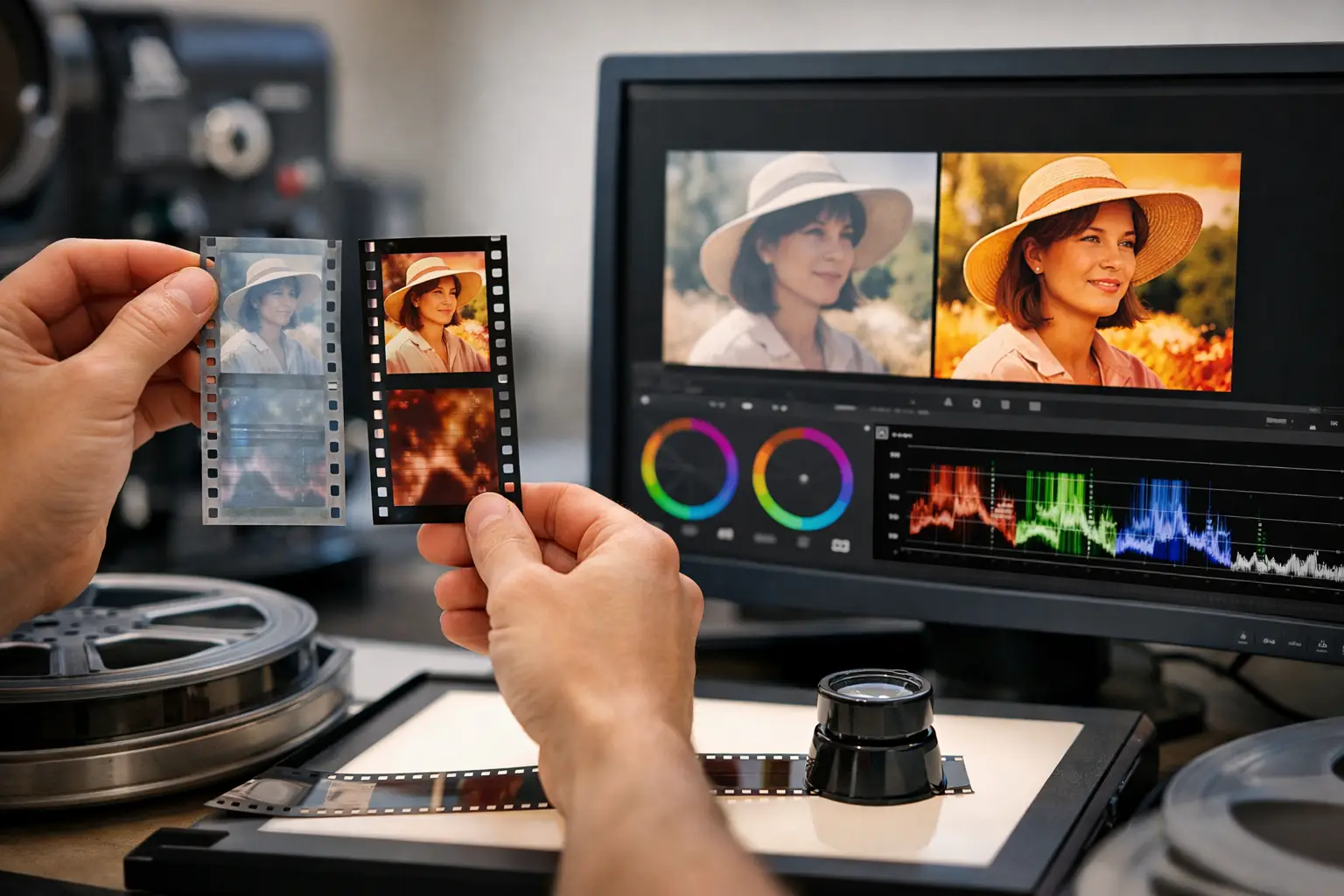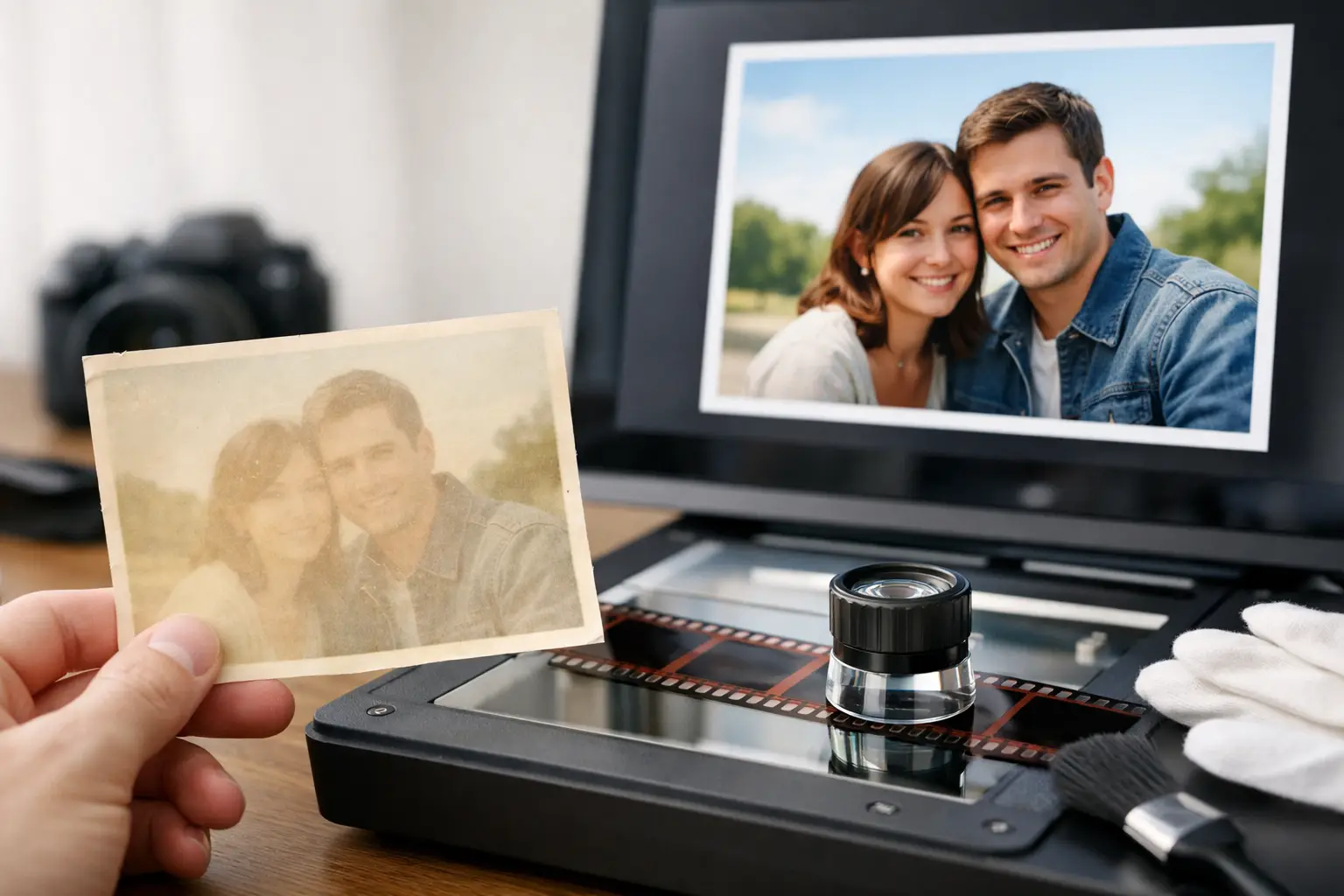
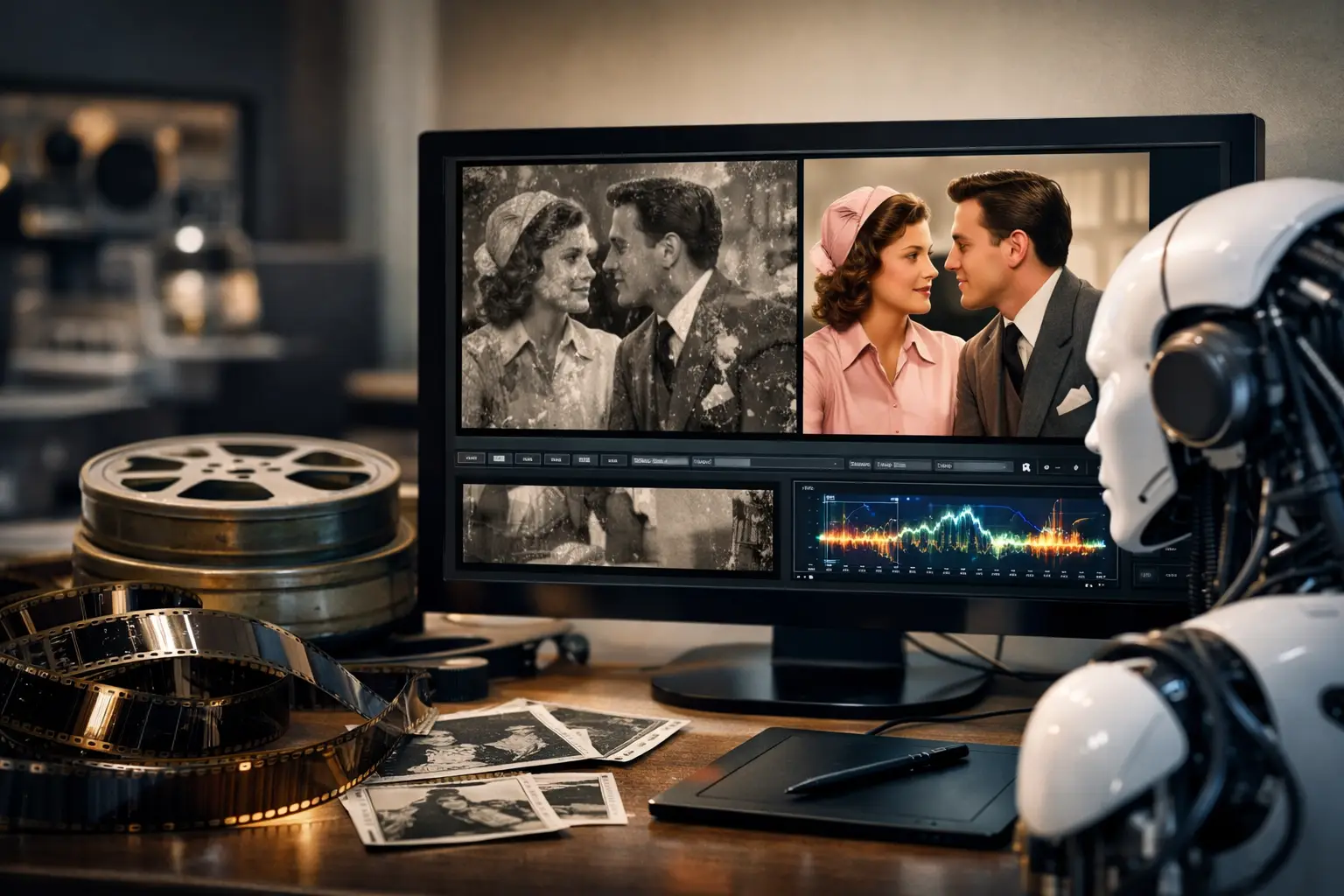
A faded Super 8 reel rarely arrives with one clean, isolated problem. It may have gate weave, embedded dust, uneven exposure, color drift, splice flashes, and grain that changes character from shot to shot. That is why AI trends in film restoration matter less as a promise of automatic repair than as a change in how restorers identify, isolate, and treat defects without sacrificing the evidence carried by the original frame.
For small-gauge archives, the real question is not whether artificial intelligence can make film look cleaner. It can. The question is whether it can do so while preserving texture, motion, facial detail, film grain, and the visual intent of material that may have no surviving reference print. The strongest workflows keep the operator in control and treat AI as one stage in a measured restoration pipeline.
Where AI Adds Real Value in Film Restoration
AI is particularly effective when a task involves pattern recognition at scale. A model can distinguish a moving dust speck from a stable feature more quickly than an operator examining thousands of frames. It can estimate motion between frames, identify damaged areas, classify shot content, and propose a repair. These capabilities reduce repetitive work, especially for long home-movie collections or commercial transfer batches.
The most useful applications are generally assistive rather than fully autonomous. Temporal dirt removal, scratch detection, stabilization support, color matching, and resolution enhancement all benefit from machine learning when the result remains reviewable. A restoration system should make it possible to preview the output, compare it with the scan, and adjust the strength of the treatment before committing to an export.
Detection is not the same as restoration
Detecting a defect is only the first step. A vertical scratch may cross a face, a moving object, or a perforation edge. A dust-removal model may correctly flag it, yet the repair still requires motion-aware reconstruction. If neighboring frames do not contain reliable image information, aggressive interpolation can replace authentic detail with plausible but invented pixels.
This distinction is central to archival work. AI can be excellent at locating likely damage. The restorer must decide whether the proposed correction is faithful enough for the purpose of the project.
Temporal Consistency Is the Hard Problem
A single restored frame can look impressive and still fail in motion. Film restoration is judged at 18, 24, or 25 frames per second, where unstable filtering becomes flicker, shifting detail, or a distracting plastic appearance. Current AI trends increasingly focus on temporal models that examine multiple frames rather than processing each image independently.
For scanned 8 mm, Super 8, 9.5 mm, and 16 mm film, this is especially relevant. Fine grain, slight registration variation, and exposure pulsing can confuse image models trained on modern digital video. A model that treats grain as noise may remove the very texture that makes the image feel photographic. One that over-smooths faces can create a waxy result that looks less credible than the original scan.
Motion-compensated tools remain essential in this context. Established techniques based on reliable frame analysis, including workflows built around MVTools2 and temporal filters such as RemoveDirtMC, provide predictable controls. AI-assisted cleanup can complement them, but it should not become a black box that makes it impossible to understand why a frame changed.
Generative Repair Requires a Clear Policy
Generative AI is the most debated development in restoration. It can fill missing regions, reconstruct damaged edges, infer detail in heavily degraded footage, and upscale very soft images. In a commercial remaster where the goal is a polished viewing experience, these tools may be appropriate when their use is documented and approved.
For preservation masters, the standard is different. Generated detail is not recovered detail. If a person’s eye, a sign, or a decorative pattern was absent from the scan because of damage, an AI-generated replacement may be visually convincing but historically uncertain. The more consequential the missing information, the stronger the case for retaining the damaged source frame or producing a separate access copy with disclosed reconstruction.
A practical policy is to maintain three distinct outputs: the untouched scan, a conservative restoration master, and a presentation version. The presentation version can use stronger stabilization, cleanup, or enhancement where appropriate. The preservation master should favor reversible, documented corrections and retain the character of the source.
A Practical AI-Assisted Restoration Workflow
AI produces better results when it is placed after sound technical preparation, not before it. A clean workflow begins with the scan itself: stable capture, correct framing, sufficient bit depth, and a codec that does not discard useful information. There is little value in applying advanced enhancement to a compressed, clipped, or poorly registered source.
The working order will vary by material, but a disciplined sequence usually looks like this:
- Inspect the scan for exposure changes, framing errors, broken splices, shrinkage, and perforation instability before applying automated cleanup.
- Stabilize mechanical movement first, using perforation-based registration when the scan and film condition support it.
- Correct broad color and gamma problems before judging whether AI detail recovery or dust removal is helping.
- Apply temporal cleanup conservatively, then inspect motion, edges, grain, and faces at full resolution.
- Encode a high-quality master before creating delivery copies in H.264, H.265, or other distribution formats.
This order prevents one correction from masking another problem. For example, grain reduction before stabilization can make frame matching less reliable. Heavy upscaling before dirt removal can enlarge scratches and make automated detection less accurate. Likewise, color correction should not be based on an AI-generated neutralization alone when faded stocks, intentional lighting, or mixed film sources are involved.
Training Data Can Limit AI Results
Most general-purpose video models are trained primarily on contemporary digital footage. That footage has different noise, motion blur, lens behavior, and color characteristics than amateur reversal film or aging acetate. A model may interpret Super 8 grain as compression noise, regard a splice flash as a scene change, or mistake film weave for camera movement.
This is why specialized controls remain valuable even as AI improves. Perforation locking addresses a physical property of film transport. Splice cleanup addresses an event specific to edited film. Chroma processing in 4:2:2 or 4:4:4 preserves more color information than a casual consumer workflow. These are not obsolete concepts. They are the technical context that determines whether an AI result is useful.
A purpose-built environment such as AvyScan Lab can provide that context by combining film-specific operations with a visual AviSynth+ workflow. The benefit is not merely automation. It is the ability to organize stabilization, dust removal, grain management, color correction, preview, batch processing, and professional encoding in an order the operator can inspect and control.
What to Measure Before Accepting an AI Result
The best test is not whether the image looks sharper in a paused frame. Evaluate short problem sections in motion: a face moving across the frame, a pan over fine detail, a shot with heavy grain, and a scene containing dust or scratches near important subjects. Compare the processed version directly with the scan.
Look for temporal artifacts, not just visible defects. Does grain pulse or disappear? Do eyes and hair shift from frame to frame? Have scratches been removed without creating smears? Did stabilization crop meaningful picture area or distort a handheld shot that was meant to move? These questions separate restoration from cosmetic filtering.
AI will continue to improve detection, tracking, interpolation, and repair. For film archives, however, the lasting trend is controlled intelligence: tools that accelerate difficult work while leaving judgment, provenance, and final image decisions with the restorer. A clean frame is valuable, but a trustworthy film is the result worth preserving.